



By Payusnomind · Mar 23, 2026
Premium
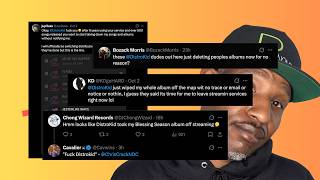 Distrokid Removing Artist Releases Witho...
  Amuse Music Distribution & Customer Supp...
  Top Music Distribution Features You Get ...
  DistroKid's Sale to CVC: What It Actuall...
  How To Turn Gmail Into A CRM With Streak
 Spotify, Apple Music, Deezer, Amazon Music, and every major DSP require recording artists and labels to operate through a digital distribution company in order to make music available on their platforms. There is no alternative. If you want your music on DSPs, distribution is unavoidable.
Today, an estimated 100,000 to 120,000 new tracks are uploaded to Spotify every single day. Digital distribution companies have effectively given anyone with the ability to record audio the power to distribute music worldwide. Artificial intelligence has only accelerated this trend by lowering the creative barrier even further - removing the need for songwriting ability, vocal performance, or production skill. In many cases, the only requirement is the ability to type a prompt.
This has created an unprecedented supply problem.
Streaming operates on a market share model, not a fixed payout system. Rights holders are not paid based on the absolute number of streams they generate, but on their percentage of total streams within a given revenue pool.
Imagine an event promotions company with a $1,000 budget to pay people to hand out flyers. If 1,000 flyers are handed out total and you distribute 100 of them, you earn 10% of the budget, or $100. If another group joins in and the total number of flyers distributed jumps to one million, your same 100 flyers now represent just 0.01% of the total—and you earn ten cents.
That percentage is market share.
Major record companies operate with a limited supply of artists and releases. Independent distribution operates with an unlimited supply. Today, major labels still control roughly half of the streaming market, but as independent releases continue to flood DSPs, that share is under constant pressure.
From an economic standpoint, there is tremendous incentive to reduce the number of releases competing for revenue, particularly those that do not add meaningful value to the platform.
This pressure is not theoretical. It has been articulated clearly by the executives who control the most valuable catalogs in the world.
Universal Music Group CEO Sir Lucian Grainge has been one of the most vocal advocates of an artist-centric royalty model. In response to criticism of these policies, Grainge dismissed opponents by saying:
“Those groups who have expressed a concern about artist-centric [models] are those whose business model is based on being merchants of garbage.”
In context, Grainge described content that generates streams but lacks genuine fan engagement, arguing that such content dilutes the value of streaming platforms and harms artists with real demand.
While Grainge was not dictating DSP policy directly, his framing has closely mirrored the direction platforms like Spotify have taken—particularly around monetization thresholds, functional music exclusions, and the prioritization of content that demonstrates listener intent through saves, follows, and library activity.
DSPs are dependent on licensing agreements with major rights holders. Their policies increasingly reflect the priorities of catalog owners whose revenue depends on maintaining market share.
Independent rights holders are feeling the consequences.
The so-called “artist-centric” model is designed to disqualify streams from monetization in order to prevent dilution of the revenue pool. This has been implemented through monetization thresholds on platforms like Spotify, Deezer, and Amazon Music. Other platforms, such as Tidal, have taken different approaches to achieving similar outcomes.
Under this system, artists are no longer competing for streams. They are competing for qualifying streams—streams that exceed a platform’s monetization threshold and demonstrate meaningful listener engagement.
A rights holder could generate well over 100,000 total streams and still earn nothing, depending on how those streams are distributed across releases and time. The goalposts have moved.
There is no universally accepted definition of streaming fraud. Platforms like Spotify define it internally, and those definitions are not transparent.
In broad terms, streaming fraud refers to any attempt to artificially inflate streams, listeners, or engagement in ways that do not reflect genuine human listening behavior.
The problem is accountability.
Artists are held 100% responsible for streaming fraud while having zero control over many of the behaviors that trigger enforcement. Anyone can playlist a song. Anyone can loop it. An artist may have no idea it’s happening and no practical way to stop it.
There is no independent investigation process. All information flows one way—from DSPs to distributors to artists.
DSPs impose penalties on distributors for suspected fraud, commonly reported as $10 per track, and risk escalating enforcement if violations are repeated. To protect themselves, distributors pass these penalties and bans down to the artists they represent.
Their reasoning is simple: their entire business depends on maintaining access to DSPs.
Streaming fraud enforcement serves a legitimate purpose: protecting the revenue pool from dilution. But it also creates a system where suspicion functions as guilt, with no transparency or due process.
This enforcement pressure has escalated sharply in recent years. Anecdotally, streaming-fraud takedowns and account bans have become one of the most common complaints cited in distributor reviews.
Browse the Trustpilot page of nearly any major distributor and you’ll see the same pattern repeated: artists banned or demonetized for fraud violations they claim they did not commit and cannot meaningfully appeal.
To combat fraud, distributors have begun adopting identity-verification standards modeled after financial compliance frameworks.
The Music Fights Fraud Alliance, an industry coalition made up of DSPs, distributors, and rights holders, refers to this process as Know Your Artist (KYA)—an artist-specific version of Know Your Customer (KYC).
According to their own documentation, KYA exists to:
Prevent fraud at the source by vetting artists and labels before they distribute music
Mitigate business risk by limiting access to “genuine, trustworthy clients”
Meet DSP compliance expectations, which increasingly require distributors to maintain strict onboarding standards
To conduct KYA checks, distributors are encouraged to:
Collect full legal names, addresses, dates of birth, and company registration details
Require government-issued ID for individuals and official registration documents for businesses
Cross-check identities against public records and databases
Perform sanctions and politically exposed person (PEP) checks
Verify that payout accounts match the vetted individual or entity
Conduct IP checks, flagging VPN use or location mismatches
Review social media presence and online activity
Request sample work to confirm the legitimacy of the catalog
This is not hypothetical. These are published best practices.
Today, being banned by one distributor is inconvenient. An artist can often move on to another platform.
But as KYA standards become more widely adopted—and as fraud-related data is increasingly shared across the industry—the margin for error shrinks.
Independent artists risk being shut out of distribution entirely, without a clear appeals process, until they reach a level of demand that allows them to bypass DIY distribution through a label deal.
DSP revenue comes from subscriptions. Subscribers pay for access and experience. DSPs value catalogs that drive demand—searches, saves, follows, playlist additions, and library plays.
Streams generated through algorithmic or commercial playlists do not create the same value. They increase payouts without increasing user attachment, effectively diluting the revenue pool.
A track that generates two monthly streams from a Premium user who saved it, follows the artist, and actively listens adds more long-term value than a track that generates 100,000 passive algorithmic streams.
Monetization thresholds remove low-demand content from the revenue pool. Fraud enforcement removes content that extracts value without adding any.
Stop obsessing over stream counts.
Yes, more streams can mean more money—but only if those streams reflect real listener demand. Artists without engaged listeners are increasingly vulnerable to demonetization, takedowns, and bans.
Ignore marketers selling screenshots of spike charts and “Spotify explosion” tactics. Focus on building an audience that actively chooses your music.
This post continues with the deeper breakdown, strategy, and implementation on the next page.