
By Payusnomind · Jan 7, 2025
Free
 Duetti Review: Great, Good, Bad, Ugly | ...
  Record Deals 2.0: From Bets on Artists t...
 Independent artists, labels, managers, and rights holders are all looking for funding.
Studio time costs money. Marketing costs money. Touring costs money. Music videos cost money. Ads cost money. Existing fans want more content, while new listeners are getting harder and more expensive to reach.
That pressure has created an entirely new lane in the music industry:
Music catalog investing.
Companies like Sonomo allow artists to sell part or all of their music rights in exchange for upfront money.
You can sell a percentage of one song, sell multiple songs, or sell an entire catalog. And depending on the size and performance of your catalog, the numbers can get very large, very quickly.
So let’s break down the Great, Good, Bad, and Ugly of Sonomo and catalog sales in general.
Advances, catalog sales, royalty financing, and music funding offers can look attractive upfront, but the real question is what you’re giving up long term. Before signing anything, run the numbers and compare your options.
Compare advances, catalog sales, repayment structures, revenue splits, fees, recoupment, and long-term earnings impact. You can also use the Funding Finder to explore companies offering advances and catalog deals.
One of the biggest selling points behind catalog sales is simple:
You can get a large lump sum of money upfront.
According to Sonomo’s pitch, artists can:
Choose what they want to sell
Receive transparent offers
Get funded quickly
Avoid hidden fees
For artists sitting on a catalog generating steady royalties, that can be extremely attractive.
Let’s say your music generates:
$500 per month
About $6,000 per year
If an investor offers a 10x multiple, they are effectively paying you ten years worth of annual earnings upfront.
That means:
$6,000 × 10 = $60,000 upfront.
That is life-changing money for many independent artists.
Especially if the artist plans to use the money strategically.
This is where catalog sales differ heavily from music “advances.”
A lot of companies market advances as funding opportunities, but many of them operate much closer to loans.
Meaning:
You owe the money back
Revenue gets recouped
Interest or fees may apply
The company gets repaid before you profit again
Catalog sales work differently.
If you sell part of your catalog:
You receive money upfront
You do not repay the money
There is no interest
There is no debt hanging over your head
That money is yours.
This distinction matters.
A lot.
This is one of the more overlooked advantages of catalog sales.
When somebody buys into your catalog, they now have a financial incentive to help your music grow.
Because if your catalog becomes more valuable:
They make more money
Their investment becomes more valuable
Their return improves
That means investors may actively push:
Playlist placements
Sync licensing
Radio opportunities
Marketing campaigns
Promotional partnerships
In other words:
You are no longer the only person trying to grow the catalog.
That changes the equation.
One of the more interesting aspects of Sonomo is its marketplace approach.
Instead of a single investor owning a catalog, Sonomo can fractionalize ownership into smaller pieces that multiple investors can purchase.
Think of it almost like stock ownership for music.
That means:
One release can have many investors
Multiple people become financially motivated
The catalog becomes a tradable asset
And this creates an interesting possibility.
What happens when investors include:
Playlist curators
Music supervisors
Radio programmers
Industry executives
Marketing professionals
Now you have people with actual influence, financially motivated to increase the value of the music.
That could potentially lead to:
More placements
More exposure
More sync opportunities
More promotional support
That incentive structure is powerful.
The marketplace model introduces another issue.
You may end up tied to people you do not know.
People who are not on your team.
People you cannot communicate with directly.
People who may have completely different goals from you.
And because they profit from your catalog increasing in value, they may push strategies you do not personally agree with.
That creates a weird dynamic where:
Your name remains attached to the music
Your reputation remains attached to the music
But you may not fully control the direction surrounding it
Now, to be fair, the investors also take on risk.
If something goes wrong:
They lose money too
Sonomo loses money too
So everyone is somewhat aligned financially.
But alignment financially and alignment creatively are not always the same thing.
This is the part artists really need to think about.
If you sell 100% ownership of your music:
They own it.
Not metaphorically.
Literally.
And even partial ownership deals may come with approval rights, licensing influence, or shared decision-making power, depending on the agreement.
That means your music could potentially end up:
In commercials
In political campaigns
In advertisements
Associated with brands or causes you disagree with
Imagine making an emotional song about wildlife preservation…
…then later hearing it used in a luxury fur coat advertisement.
That emotional disconnect is real.
And it is one of the major tradeoffs artists underestimate when discussing catalog sales.
Money comes with concessions.
The question is:
Which concessions are you personally willing to make?
This is where catalog sales become deeply personal.
Some artists see music primarily as:
Intellectual property
Assets
Revenue-generating products
Others see songs as almost like children.
Memories.
Moments.
Pieces of themselves.
Those artists may struggle emotionally with selling ownership.
Even if financially it makes perfect sense.
That emotional component cannot be ignored.
The most important part of catalog sales is not the sale itself.
It is what you do with the money afterward.
If an artist sells part of a catalog and uses the money to:
Build a stronger business
Invest in marketing
Fund touring
Acquire assets
Expand operations
Grow future revenue
Then the decision could make tremendous sense.
But if the money disappears with no long-term strategy behind it?
That is a completely different conversation.
Catalog sales are becoming a major part of the independent music business.
For some artists, selling part of a catalog can unlock opportunities that would have taken years to build otherwise.
For others, the loss of ownership and control may never feel worth it.
There is no universal answer.
Only tradeoffs.
That is why understanding:
Multiples
Ownership rights
Approval clauses
Licensing permissions
Revenue projections
Long-term goals
…matters so much before signing anything.
On Payusnomind, we explore these topics deeper through:
Catalog valuation analysis
Funding breakdowns
Music finance education
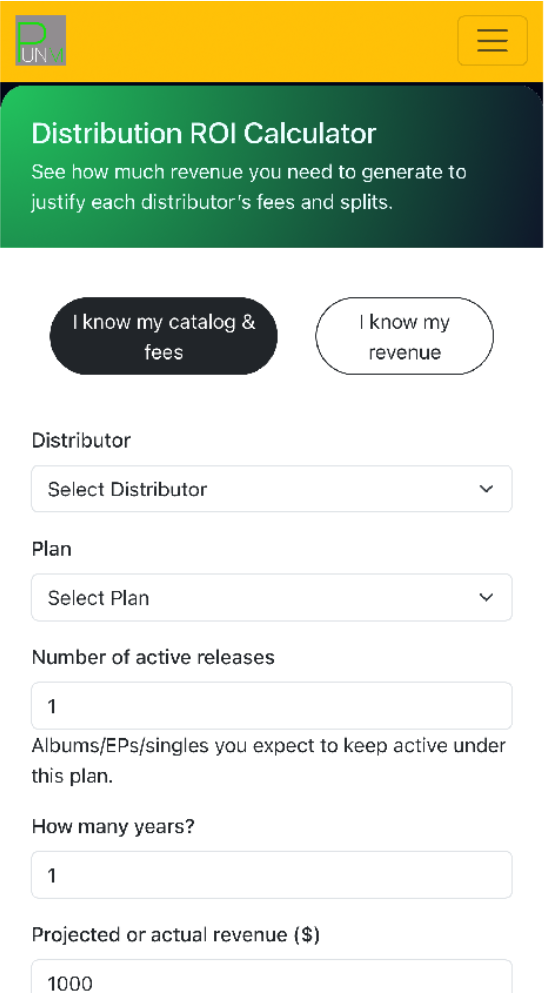
ROI calculators
Independent artist strategy content
You can also use our catalog valuation calculator to estimate what your catalog could potentially be worth based on revenue and projected multiples.
And if you are considering selling music rights, we offer a free 15-minute consultation to help artists think through
Potential risks
Long-term implications
Funding strategy
Contract concerns
Whether the move actually makes sense for their goals
Sometimes it helps to simply have somebody objective in your corner before making a major decision.