

By Payusnomind · Sep 21, 2024
Free

Keeping your music in stores sounds like a win.
And it is.
But it’s not free.
You stop paying your subscription.
Your music stays live.
But now:
Amuse takes 25%
That’s a significant cut.
Higher than most “free” models.
If your music isn’t earning much, it doesn’t matter.
If it starts earning:
that 25% adds up fast
At that point, you would’ve been better off staying on a flat-fee model elsewhere.
Amuse has changed its model before.
It started with free distribution.
Moved to subscriptions.
Adjusted pricing.
Introduced new tiers.
Made changes that affected how artists kept their music live.
Now it’s offering a version of “stay in stores” again.
That matters.
Because it shows the model isn’t fixed.
Amuse distributes to many stores.
But reporting focuses on the major ones.
Even exported data doesn’t fully reflect everything.
That creates a blind spot.
And for artists trying to optimize performance, that’s a problem.
Amuse is part of a broader ecosystem that monitors streaming fraud.
Warnings, removals, fines.
That’s standard now.
But it’s still a risk, especially if you’re dealing with third-party promotion.
Amuse offers:
email collection
pre-saves
mobile tools
team access
But most of these features:
don’t integrate into a larger system
You get the data.
But you don’t get a way to use it effectively inside the platform.
Amuse is trying to be:
a distributor
a toolset
a service platform
At the same time.
That’s why it feels balanced.
But it also means it doesn’t dominate in any one area.
Against DistroKid:
DistroKid is simpler
Amuse is more flexible
Against RouteNote:
RouteNote is cheaper
Amuse offers more structure
Against TuneCore:
TuneCore is more reliable
Amuse is more adaptable
Artists who want flexibility.
Artists who may stop and start releases.
Artists outside the U.S. benefiting from tax differences.
Artists scaling revenue.
Artists needing detailed reporting.
Artists wanting long-term pricing stability.
You’re trading:
certainty
for:
flexibility
That works.
Until it doesn’t.
Pricing
Flexible, but variable
Features
Decent, not deep
Transparency
Mixed
Risk
Moderate (model changes + ecosystem)
Value
Situational
Amuse is a middle-ground platform.
And like most middle-ground options, it works best for artists who don’t have extreme needs in any direction.
If you need flexibility, it’s worth considering.
If you need consistency, control, or long-term cost efficiency, there are better options.
Use the Distribution Selector to see if Amuse fits your situation.
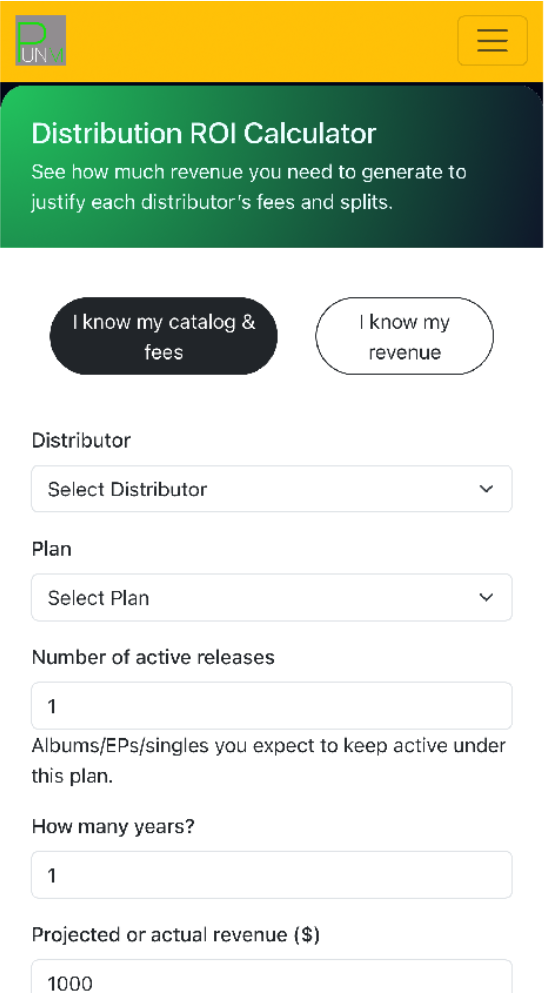
If you’re comparing it to other platforms, run your catalog through the ROI calculator.
If you’re unsure how the 25% model impacts you long-term, book a consultation.